
"Judge Pandit House Durga Puja" A Legacy of Faith and Mystery
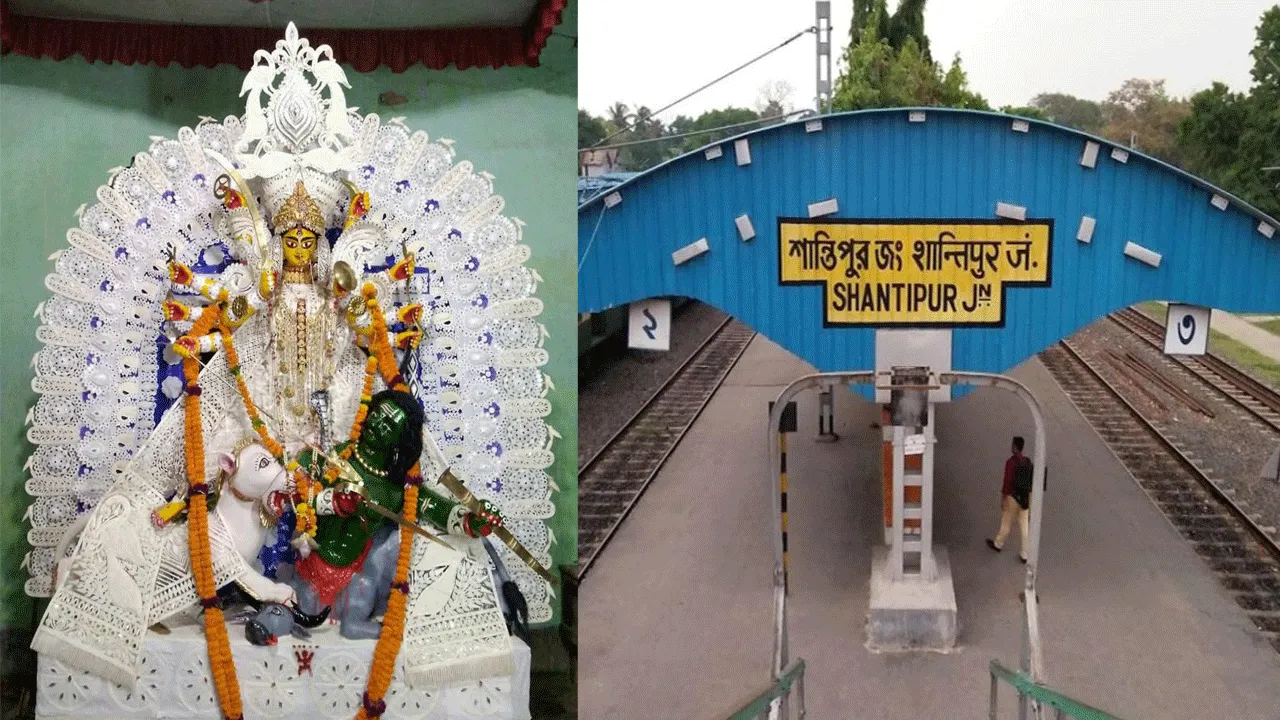
No Lakshmi or Saraswati. No Kartik or Ganesh. At the historic Judge Pandit family home in Shantipur, Nadia district, Durga is worshipped alone in a traditional single-frame idol as Mahishasuramardini, the slayer of the buffalo demon Mahishasura. Beneath the idol lies a Panchamundi asana, a sacred seat associated with Tantric spiritual practices. The centuries-old puja remains a testament to enduring faith and tradition.
Preparations begin on Rath Yatra day, when vermilion is applied to a wooden plank as part of the traditional rites. The goddess is ceremonially invoked at a designated spot beneath the Panchabati near the family home. In Hindu religious tradition, a Panchabati is a sacred grouping of five trees. Following the Shakta tradition, family members themselves conduct the worship, preserving rituals passed down through generations.
The puja’s origins lie in Gaya, Bihar. Pitambar Chattopadhyay, a member of a prominent zamindar family from Jadua village, earned the title Tarkabagish in recognition of his scholarship in the scriptures. His learning earned him respect among the British as well. He also adjudicated disputes involving the family’s tenants, earning him the name ‘Judge Pandit’. Over time, the title became associated with the family home in Shantipur.
Why Pitambar left Gaya and settled in Shantipur remains unknown. He established a new zamindari there and began the family’s Durga Puja. Although the estate has lost much of its former grandeur, the annual worship continues.
The family worships an earthen idol of Durga in accordance with the Devi Purana. The offerings reflect Bengal’s culinary traditions: banana blossom and taro greens on Saptami; hilsa with plain rice on Ashtami; hog-plum chutney on Navami; and fermented rice, taro greens and raw banana fritters on Dashami.
The puja once had a distinctive attraction: a Belgian lantern that illuminated the goddess. Dr Sanchari Chattopadhyay, a daughter of the Judge Pandit family, says the goddess was once worshipped under the glow of the lantern. After it was stolen, electric lighting was introduced. Although the lighting has changed, the family remains committed to preserving the traditions of the puja.
The household also has a literary connection. Bibhutibhushan Bandyopadhyay, one of Bengal’s best-known novelists, is remembered as having visited the family’s Durga Puja. He came through his friendship with Bholanath Bandyopadhyay, the poet of Ashru, who was married to Nirmala Devi, a daughter of the Judge Pandit family.
Dr Subhadip Bandyopadhyay, Bholanath’s great-grandson, says the exact year of Bibhutibhushan’s visit is unknown. The memory, however, survives through family tradition.
Devotees regard the goddess as jagrata — a deity believed to respond to prayers. This enduring faith continues to draw visitors from far and wide.
The zamindari’s former grandeur may have faded, and electric lights may have replaced the lantern’s glow, but the solitary Durga remains at the heart of a tradition sustained by faith, family history and Shantipur’s cultural heritage.








Recent News



Most Viewed
Lifestyle
Lifestyle
Lifestyle
Culture
Entertainment