

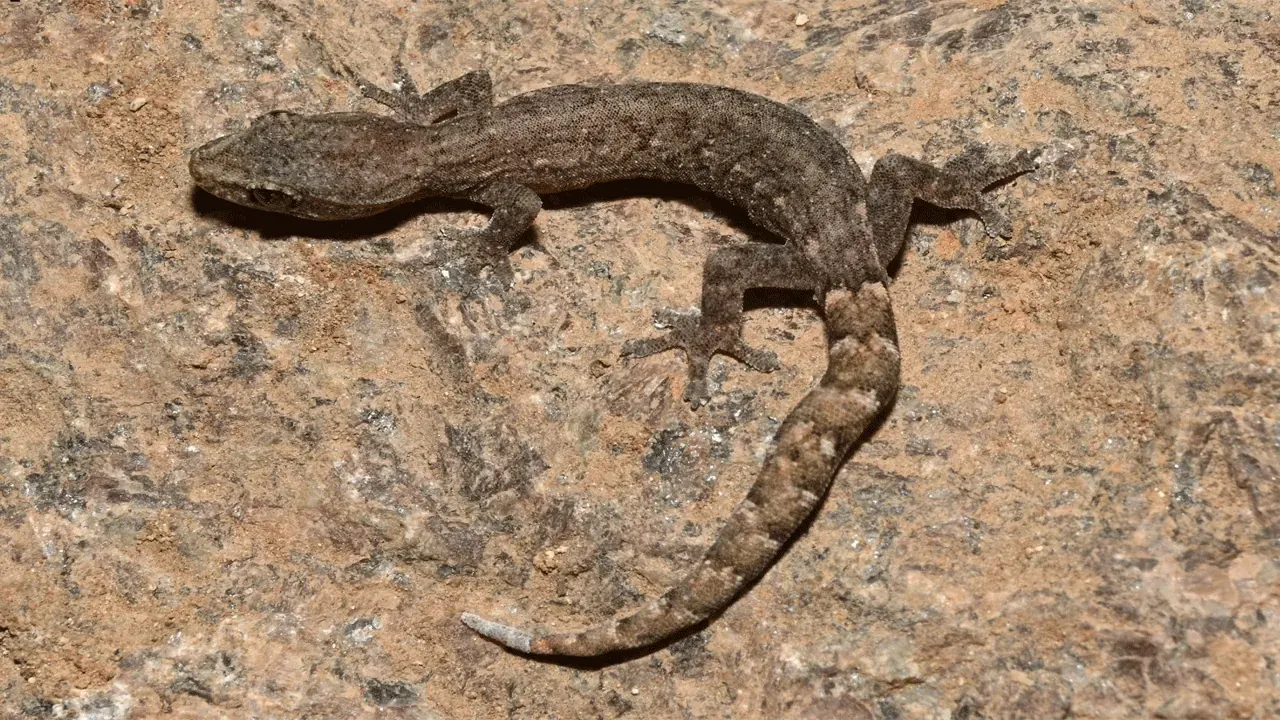
New species of slender gecko discovered and descripted
Scientists from the Zoological Survey of India (ZSI) have discovered and descripted a new species of slender gecko, adding to the known biodiversity of the Eastern Ghats.
The newly described species, belonging to the genus Hemiphyllodactylus, was found in the Tirumala Hill ranges within the Seshachalam Biosphere Reserve, Andhra Pradesh. It has been officially named Hemiphyllodactylus venkatadri sp. nov., paying homage to its type locality, the sacred Venkatadri Hills in Tirumala. The name Venkatadri is a blend of the Sanskrit words Venkata (meaning ‘one who removes sins,’ a name for Lord Vishnu) and Adri (meaning mountain).
Significant Scientific Findings: The discovery, published in the international journal Herpetozoa (Vol. 38, 2025), was a collaborative effort by a team from ZSI’s Freshwater Biology Regional Centre (Hyderabad), Reptilia Section (Kolkata), and Fakir Mohan University (Odisha).
Molecular analysis confirms the gecko's status as a distinct species, showing a 9.7–12.9% genetic divergence from its closest relatives in peninsular India, including H. jnana, H. nilgiriensis, and H. peninsularis.
Key morphological features setting the Venkatadri Slender Gecko apart include:12–16 chin scales. 6–8 precloacal pores and 5–7 femoral pores separated by poreless scales. A characteristic lamellar pattern of 2-2-2-2 on both limbs. The gecko was discovered from under tree bark in a sandalwood plantation surrounded by tropical dry deciduous forest at approximately 881 metres elevation.
Highlighting Underexplored Biodiversity: This is only the second species of the genus Hemiphyllodactylus to be reported from Andhra Pradesh, the first being H. arakuensis.
Dr. Dhriti Banerjee, Director, ZSI, congratulated the research team. “Discoveries like the Venkatadri Slender Gecko strongly reiterate the need for continued systematic exploration and molecular research in the Eastern Ghats,” she stated. “This region remains one of India’s most underexplored biogeographic areas, yet it continues to yield a rich and growing list of new reptile species.” The discovery underscores the critical need for biodiversity conservation in the region.








Recent News






Most Viewed
Lifestyle

Lifestyle

Lifestyle

Culture

Entertainment