

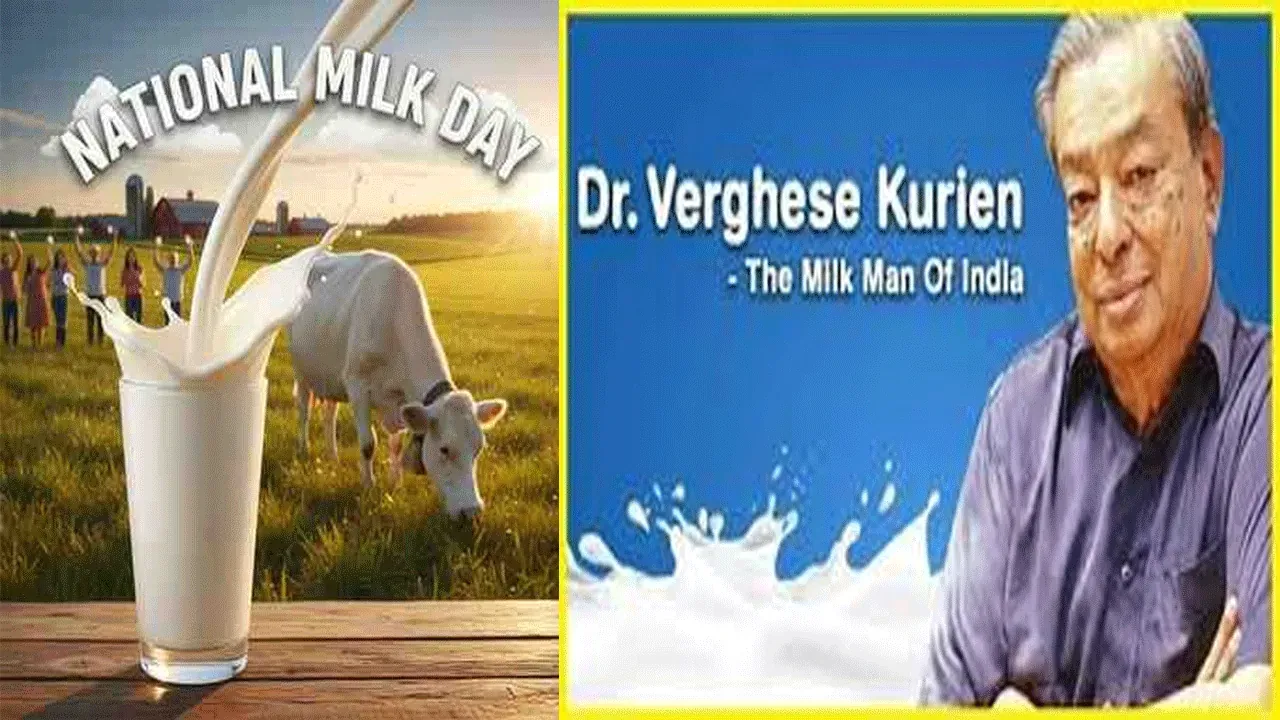
National Milk Day: Honouring the White Revolution
Milk occupies a central place in India’s nutritional landscape, providing high-quality animal protein and essential nutrients such as calcium, magnesium, potassium, and other micronutrients in easily absorbable forms. Often regarded as a near-complete food, milk supports growth, bone health, and vitality across all age groups. India has consistently retained its position as the world’s leading milk producer, contributing nearly one-fourth of global output. Over the last 11 years, India’s dairy sector has expanded significantly by 70 percent, contributing around 5 percent of the national economy and providing direct employment to over 8 crore farmers (as per the National Accounts Statistics). Furthermore, Women farmers play a significant role in production and collection, making dairy a strong vehicle for inclusive and gender-responsive growth.
National Milk Day is observed on 26th November every year to mark the birth anniversary of Dr. Verghese Kurien, regarded as the “Father of the White Revolution” in India. The day honours millions of farmers, whose commitment sustains the country’s leadership in milk production and strengthens its journey towards a resilient, inclusive, and nutritionally secure future.
India had a milk shortage and was dependent on imports during the 1950s and 1960s. Throughout the first decade after independence, milk production recorded a CAGR of 1.64%, which fell to 1.15% during the 1960s. This was despite the country having the world’s largest cattle population. The modern dairy movement in India was built upon the success of the Anand cooperative model that had flourished under the guidance of leaders like Sardar Vallabhbhai Patel, Mahatma Gandhi, and Tribhuvandas Patel. The National Dairy Development Board (NDDB) was created in 1965, with Verghese Kurien appointed as its first chairman. The Board’s mission was to replicate the Anand cooperative model across India and organize farmers into strong, village-level milk producer societies.
Building on the achievements of the Kaira District Cooperative Milk Producers’ Union, the precursor to Amul, the NDDB launched Operation Flood in 1970. This ambitious programme sought to increase rural milk production and develop a streamlined system that enabled cooperatives in milk-rich regions to supply milk efficiently to major urban markets. The initiative transformed India from a milk-deficient nation into the world’s largest milk producer. Recognizing its significant national impact and contribution to dairy development, the NDDB was designated an Institution of National Importance by an Act of Parliament in 1987.
Over the past decade, India’s dairy sector has experienced remarkable growth. Milk production increased by 63.56 percent from 146.30 million tonnes in 2014 - 15 to 239.30 million tonnes in 2023-24. Per-capita milk availability has also surged from 124 grams to 471 grams per person per day. India’s dairy economy is anchored by its 303.76 million bovines, including cattle, buffalo, mithun, and yak. Between 2014 and 2022, bovine productivity (kg/year) grew by 27.39 percent, the highest growth globally and significantly above the world average of 13.97 percent. Sheep (74.26 million), and goats (148.88 million) continue to make a significant contribution, especially in arid and semi-arid regions, where they support milk production. The number of milch animals has expanded from 86 million to 112 million, while milk production from indigenous cow breeds has risen from 29 million tonnes to 50 million tonnes. This success is driven by initiatives such as the Rashtriya Gokul Mission and the Livestock Health and Disease Control Programme (LHDCP), which focus on enhancing breeding, improving genetic quality, and promoting animal health. Additionally, the integration of Ethnoveterinary Medicine (EVM)with Ayurveda offers sustainable, low-cost alternatives to antibiotics, thereby enhancing the overall health and resilience of livestock.
National Milk Day 2025 reflects the evolution of India’s dairy sector from the cooperative foundations laid in Anand to its present position as the world’s leading milk producer. The progress achieved through Operation Flood, the strengthening of dairy cooperatives, and sustained government support has resulted in substantial gains in overall milk production, rising per-capita availability, and improved bovine productivity. Programmes such as the Rashtriya Gokul Mission, the National Artificial Insemination Programme, and the National Programme for Dairy Development have expanded the reach of scientific breeding, improved animal health services, and strengthened dairy infrastructure.
The growing prominence of women-led cooperatives, large-scale producer organisations, and major dairy institutions, such as Amul and Sabar Dairy, underscores the sector's inclusivity and its increasing economic impact. The reforms under the GST Council, enhanced processing capacity, and the focus of White Revolution 2.0 further reinforce India’s commitment to a stronger and more sustainable dairy system. As the country observes National Milk Day, it acknowledges the farmers and cooperatives whose efforts continue to shape a resilient, productive, and forward-looking dairy economy.







Recent News

Most Viewed
Lifestyle

Lifestyle

Lifestyle
Culture
Entertainment