

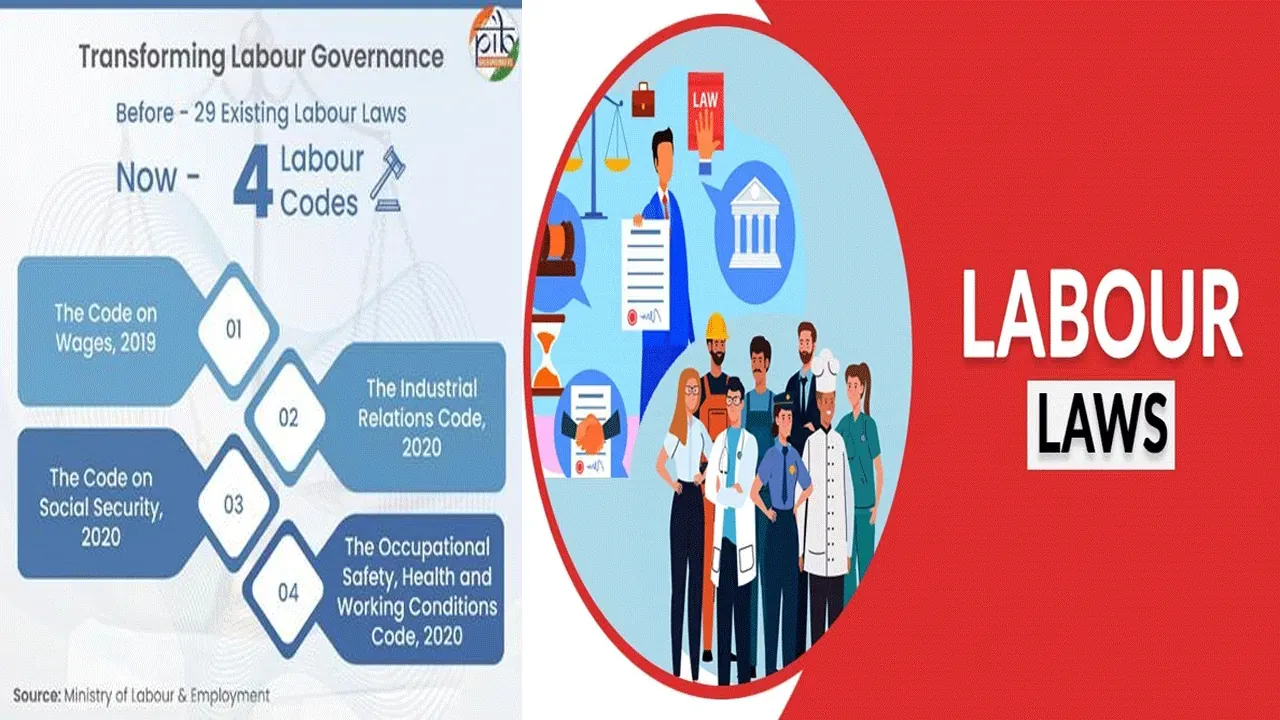
Government Makes the Four Labour Codes effective to Simplify and Streamline Labour Laws
In a historic decision, the Government of India has announced that the four Labour Codes - the Code on Wages, 2019, the Industrial Relations Code, 2020, the Code on Social Security, 2020 and the Occupational Safety, Health and Working Conditions Code, 2020 are being made effective from 21st November 2025, rationalising 29 existing labour laws. By modernising labour regulations, enhancing workers' welfare and aligning the labour ecosystem with the evolving world of work, this landmark move lays the foundation for a future-ready workforce and stronger, resilient industries driving labour reforms for Aatmanirbhar Bharat.
Many of India’s labour laws were framed in the pre-Independence and early post-Independence era (1930s–1950s), at a time when the economy and world of work were fundamentally different. While most major economies have updated and consolidated their labour regulations in recent decades, India continued to operate under fragmented, complex and in several parts outdated provisions spread across 29 Central labour laws. These restrictive frameworks struggled to keep pace with changing economic realities and evolving forms of employment, creating uncertainty and increasing compliance burden for both workers and industry. The implementation of the four Labour Codes addresses this long-pending need to move beyond colonial-era structures and align with modern global trends. Together, these Codes empower both workers and enterprises, building a workforce that is protected, productive and aligned with the evolving world of work — paving the way for a more resilient, competitive and self-reliant nation.
Beyond the major welfare initiatives already highlighted, the Labour Codes introduce several further reforms that strengthen worker protection and simplify compliance for employers:
- National Floor Wage to ensure no worker receives a wage below the minimum living standard.
- Gender-neutral pay and job opportunities, explicitly prohibiting discrimination—including against transgender persons.
- Inspector-cum-Facilitator system, shifting enforcement towards guidance, awareness and compliance support rather than punitive action.
- Faster and predictable dispute resolution, with two-member Industrial Tribunals and the option to approach tribunals directly after conciliation.
- Single registration, single licence and single return across safety and working-conditions requirements, replacing multiple overlapping filings.
- National OSH Board to set harmonised safety and health standards across sectors.
- Mandatory safety committees in establishments with 500+ workers, improving workplace accountability.
- Higher factory applicability limits, easing regulatory burden for small units while retaining full safeguards for workers.
In line with the wide-ranging consultations carried out during the drafting of the Labour Codes, the Government will likewise engage the public and stakeholders in the framing of the corresponding rules, regulations, schemes, etc. under the Codes. During transition, the relevant provisions of the existing labour Acts and their respective rules, regulations, notifications, standards, schemes, etc. will continue to remain in force.
Over the past decade, India has expanded social-security coverage dramatically, rising from about 19% of the workforce in 2015 to more than 64% in 2025, ensuring that protection and dignity reach workers across the country, and also earning recognition in the global arena for this milestone achievement in social protection. The implementation of the four Labour Codes marks the next major step in this trajectory, further widening the social-security net and embedding portability of benefits across states and sectors. With expanded social security, stronger protections and nationwide portability of entitlements, the Codes place workers, especially women, youth, unorganised, gig and migrant workers, firmly at the centre of labour governance. By reducing compliance burden and enabling flexible, modern work arrangements, the Codes boost employment, skilling and industry growth, reaffirming the Government’s commitment to a pro-worker, pro-women, pro-youth and pro-employment labour ecosystem.







Recent News





Most Viewed
Lifestyle

Lifestyle

Lifestyle

Culture

Entertainment