

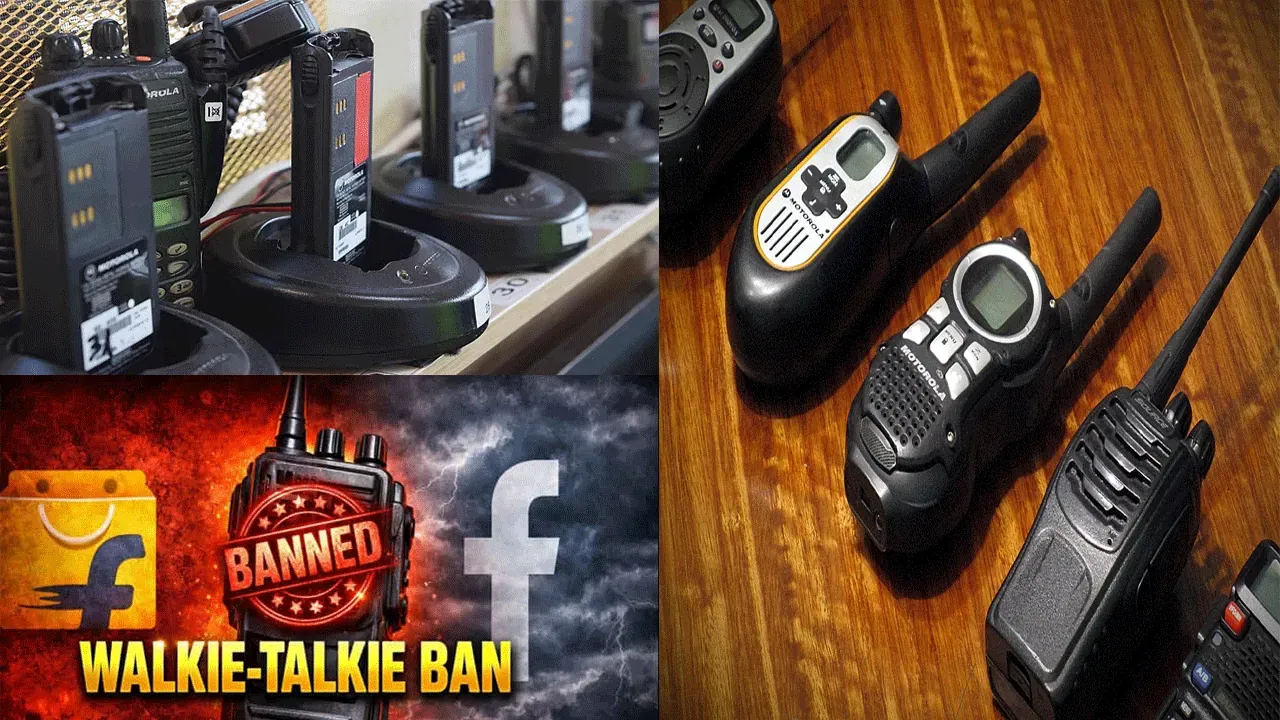
Unauthorized Sale of Walkie-Talkies on E-Commerce Platforms, over 16,900 Non-Compliant Listings Identified
The Central Consumer Protection Authority (CCPA) has taken suo motu cognisance of the large-scale illegal listing and sale of walkie-talkies (Personal Mobile Radios PMRs) on e-commerce platforms and has imposed monetary penalties on leading online marketplaces for violations of consumer protection and telecom regulations.
The action follows the identification of over 16,970 non-compliant walkie-talkie listings across platforms. Notices were issued to 13 e-commerce entities, including Amazon, Flipkart, Meesho, JioMart, Meta (Facebook Marketplace), Talk Pro, Chimiya, MaskMan Toys, India Mart, TradeIndia, Antriksh Technologies, Vardaanmart and Krishna Mart.
The Authority found that several platforms were facilitating the sale of walkie-talkies operating on restricted and sensitive radio frequency bands, without mandatory statutory approvals or disclosures. These devices were sold without informing consumers about:
- The radio frequency range on which the device operates
- Whether the device requires a government licence
- Whether it has obtained Equipment Type Approval (ETA). It is a mandatory technical approval issued by the Department of Telecommunications (DoT) to ensure that wireless devices are compliant, safe and permitted for use in India (WPC)
Many of these devices were found to operate in the Ultra High Frequency (UHF) band, which is a regulated spectrum also used by police, emergency services, disaster response agencies and other critical communication networks. Several products were wrongly advertised as “license-free” or “100% legal,” even though their use requires government approval. In some cases, walkie-talkies were sold as toys but had very long communication ranges of up to 30 kilometers. In addition, many product listings did not clearly mention important details such as the operating frequency or whether the device had Equipment Type Approval (ETA), making it difficult for consumers to know if the product was legal to buy and use.
The sale, import and use of walkie-talkies in India are regulated under:
- The Indian Telegraph Act, 1885
- The Indian Wireless Telegraphy Act, 1933
- The Use of Low Power and Very Low Power Short Range Radio Frequency Devices (Exemption from Licensing Requirement) Rules, 2018
Under these rules, only walkie-talkies operating strictly within the 446.0–446.2 MHz frequency band are exempted from licensing. Even such licence-exempted devices must obtain ETA certification before being imported or sold in India. Failure to comply with these requirements also constitutes misleading advertisement, unfair trade practice and deficiency in service under the Consumer Protection Act, 2019, and violates the Consumer Protection (E-Commerce) Rules, 2020.
To prevent recurrence of such violations, the CCPA has notified the Guidelines for the Prevention and Regulation of Illegal Listing and Sale of Radio Equipment including Walkie-Talkies on E-Commerce Platforms, 2025, in consultation with the Department of Telecommunications (DoT) and the Ministry of Home Affairs (MHA).
These Guidelines require e-commerce platforms to:
- Verify frequency compliance before allowing listings
- Ensure ETA certification prior to sale
- Clearly disclose licensing requirements to consumers
- Prohibit misleading claims such as “license-free” or “100% legal”
- Deploy automated monitoring and takedown systems for illegal listings
The CCPA, headed by Chief Commissioner Smt. Nidhi Khare and Commissioner Shri Anupam Mishra, has issued final orders in eight cases, namely:
- Meesho (Fashnear Technologies Pvt. Ltd.)
- Talk Pro (Iconet Services Pvt. Ltd.)
- MaskMan Toys
- Chimiya
- JioMart
- Meta Platforms Inc. (Facebook Marketplace)
- Flipkart Internet Private Limited
- Amazon Seller Services Pvt. Ltd.
Proceedings against Antriksh Technologies, India Mart, TradeIndia, Vardaanmart and Krishna Mart are currently at various stages of investigation or hearing.
In the matter concerning Chimiya.com, CCPA found that the platform was offering for sale rechargeable two-way walkie-talkie radios operating in the UHF 400-470 MHz band, which fall outside the license-exempt spectrum permitted in India. These devices were imported from overseas jurisdictions and were listed without mandatory regulatory disclosures, including Equipment Type Approval (ETA) and verification of operation strictly within the 446.0–446.2 MHz band. Such devices cannot be imported, advertised or sold in India without requisite statutory approvals. CCPA held that the platform failed to exercise due diligence and violated the Consumer Protection Act, 2019 and applicable telecom regulations.
The e-commerce platform JioMart (www.jiomart.com) was found to have offered walkie-talkie devices for sale without clear and conspicuous disclosures regarding licensing requirements and regulatory compliance. Over a period of two years, 58 units of such devices were sold through the platform. The Authority noted that omission of mandatory information has the potential to expose consumers to legal and technical risks associated with unauthorized use of wireless communication equipment.
CCPA found that Talk Pro (Iconet Services Pvt. Ltd.) listed and sold walkie-talkie devices operating across wide frequency ranges, including UHF 400–1200 MHz, while falsely representing them as “100% legal” and “license-free.” The entity also made misleading and contradictory claims regarding the operational range of the devices, advertising significantly higher ranges than disclosed elsewhere. Investigations established that these devices were sold without disclosure of licensing obligations or ETA requirements, amounting to misleading advertisement and unfair trade practice.
In the matter of Meesho (Fashnear Technologies Pvt. Ltd.), the CCPA observed large-scale listing and sale of walkie-talkie devices by multiple sellers without furnishing mandatory licensing or certification details. It was noted that details were furnished only in respect of one seller, whose particulars were annexed to the notice, indicating that 2,209 units of the concerned product were sold by that seller alone. Further, numerous walkie-talkie listings on the platform did not disclose ETA certification or frequency specifications, and the platform was unable to demonstrate effective seller verification or regulatory compliance mechanisms. Such omissions were found to be in violation of the Consumer Protection Act, 2019 and the Consumer Protection (E-Commerce) Rules, 2020.
In the matter of MaskMan Toys, CCPA observed that walkie-talkies of varying communication ranges, including 10 km, 20 km and 30 km, were listed without disclosure of frequency range, licensing requirements or ETA/WPC certification status. Despite being marketed as toys, the technical capabilities of the devices exceeded toy classifications. The absence of fundamental regulatory information rendered it impossible for consumers to ascertain the legality of the products and constituted a serious lapse under the Consumer Protection Act, 2019.
In the matter concerning Flipkart, CCPA found that walkie-talkie devices were listed and sold on the platform without mandatory disclosures relating to frequency range, licensing requirements and ETA/WPC certification status. A large number of sellers were found to have listed such devices, resulting in significant sales. Data furnished revealed that 42,275 units were sold with the exact license-exempt frequency range disclosed, whereas 65,931 units were sold where the frequency range was either left blank or was outside the exempted range. The Authority observed that failure to verify and disclose such information compromised consumers’ right to be informed and constituted misleading advertisement and unfair trade practice under the Consumer Protection Act, 2019.
In the case of Facebook Marketplace, CCPA found that walkie-talkie devices were listed, hosted and advertised without disclosure of licensing requirements, frequency specifications or ETA/WPC certification. Despite post-notice removals, the platform was found to have facilitated repeated listing of regulated radio communication devices without adequate preventive safeguards. The Authority held that such listings amount to misleading advertisements and that platforms facilitating public discovery and promotion of regulated products are required to exercise due diligence commensurate with their scale and technological capability, pursuant to which a total of 710 such listings were delisted as a result of the Authority’s intervention.
In the matter concerning Amazon Seller Services Pvt. Ltd., the CCPA took suo motu cognizance of the listing and sale of a large number of walkie-talkies, also known as Personal Mobile Radios (PMRs), on the platform without necessary statutory disclosures. Examination of the platform revealed that 467 product listings for walkie-talkies had been put up by sellers, most of which did not disclose the operating frequency bandwidth or the certification obtained from the Department of Telecommunications (DoT). Further, data furnished in the appendix to the response indicated that 2,602 units were sold during the period from January 2023 to May 2025, along with details of the concerned sellers and relevant order and invoice particulars. The Authority observed that such omissions deprived consumers of material information necessary for informed decision-making and amounted to misleading advertisement and unfair trade practice under the Consumer Protection Act, 2019.
Penalties and Directions
Some e-commerce platforms claimed that they were only intermediaries and were not responsible for products listed by third-party sellers. The CCPA rejected this claim and clarified that platforms which allow the listing, promotion and sale of regulated products cannot avoid responsibility. Such protection is available only when platforms carry out proper checks and due diligence.
The Authority imposed penalties of ?10 lakh each on Meesho, Flipkart, Amazon and Meta Platforms Inc, and ?1 lakh each on Chimiya, JioMart, Talk Pro and MaskMan Toys. Several platforms have already paid the penalty amounts, while payment from the remaining entities is awaited.
The CCPA has directed all platforms to ensure that walkie-talkies and other radio equipment are not listed or sold without required government approvals. Platforms have also been asked to conduct regular self-audits, publish compliance certificates, and ensure that no regulated wireless equipment is sold unless it fully complies with the law.
Public Safety and National Security Implications
The Authority noted that unauthorised radio devices can cause harmful interference with communication systems used by law-enforcement agencies, disaster management authorities and emergency services, posing serious risks to public safety, public order and national security.
CCPA reiterated that consumers rely heavily on online descriptions and specifications while shopping. The sale of non-compliant walkie-talkies misleads consumers, exposes them to legal and regulatory risks, and undermines trust in digital marketplaces.
The Authority reaffirmed its commitment to protecting consumer rights, preventing unfair trade practices and ensuring a safe and transparent digital marketplace, and urged all e-commerce platforms to exercise strict regulatory verification and accurate disclosures when listing radio communication devices.








Recent News






Most Viewed
Lifestyle

Lifestyle

Lifestyle

Culture

Entertainment