
Bal Vivah Mukti Rath Travels 27,055 Km Across West Bengal to Raise Awareness Against Child Marriage
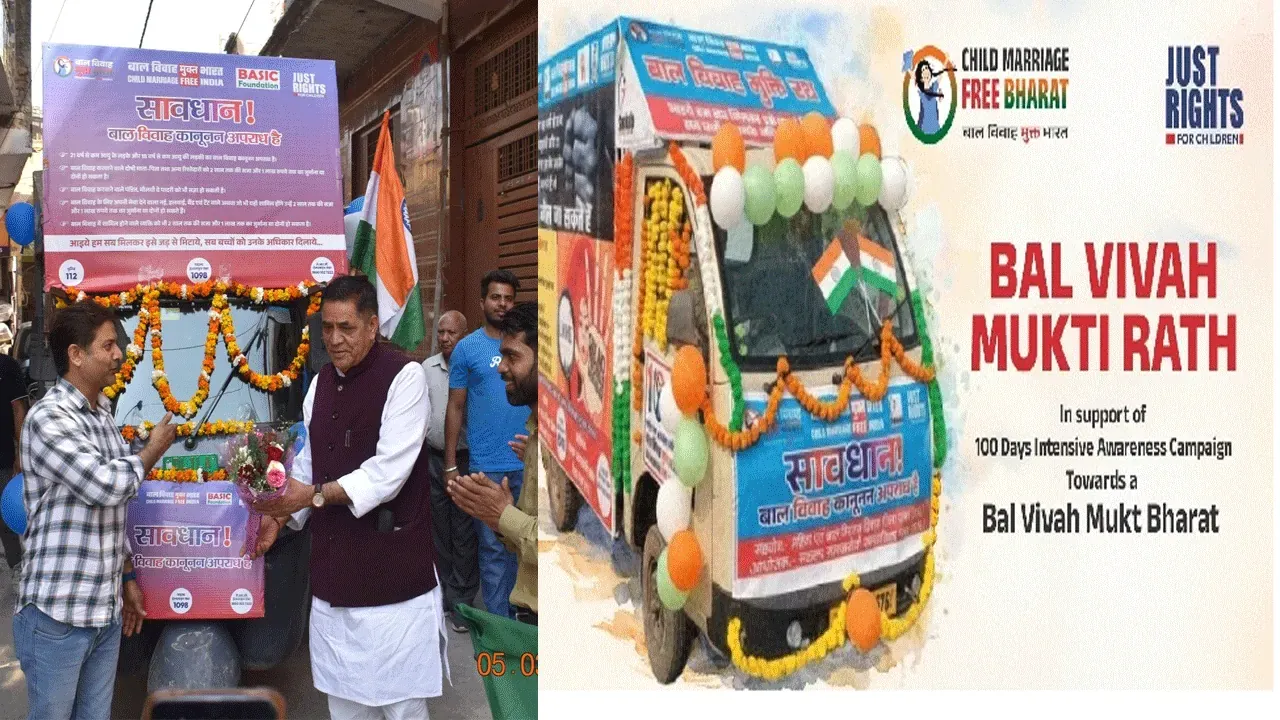
The Bal Vivah Mukti Rath, a unique campaign on wheels that travelled across 2567 villages, reaching over 10,57,150 people and covering a distance of 27,055 kilometres across the state with the message of a child marriage free West Bengal, culminated on International Women’s Day. Launched by Just Rights for Children as part of the Government of India’s 100 Days Intensive Campaign to End Child Marriage, the campaign saw over 500 similar Bal Vivah Mukti Rath vehicles traverse the length and breadth of the country, mobilising and sensitising the communities about the laws against child marriage. Just Rights for Children is the country’s largest network of NGOs working on child protection and child rights, with over 250 partner organisations across India, of which 14 partners are based in West Bengal.
The campaign was notable for the unprecedented support it received across the state. Politicians, women survivors, civil society organisations, police personnel and faith leaders came together, cutting across political parties, ideologies, social backgrounds and religions, to strengthen the collective resolve to end child marriage by 2030. In Kolkata, West Bengal Women and Child Development and Social Welfare Minister, Dr Shashi Panja flagged off the Bal Vivah Mukti Rath earlier last month.
During its month-long journey across the state, the Bal Vivah Mukti Rath covered schools, gram sabhas, religious institutions and historical sites, spreading the message through 827 events, including rallies, nukkad nataks, pledge ceremonies, cultural programmes and survivors’ stories. Over 898 schools and colleges and 1,598 religious places were covered during the journey, with participation from 1,66,776 students and teachers, and 3457 faith leaders.
As per the government data for 2019-21, prevalence of child marriage in West Bengal is much higher at 41.6 percent as against the national average of 23.3 percent. Across the country, the Bal Vivah Mukti Raths were flagged off by chief ministers, deputy chief ministers, members of Parliament, district magistrates, and even speakers and deputy speakers of state legislatures. In total, 2 chief ministers, 49 state ministers, 82 members of Parliament and 154 members of legislative assemblies, apart from 99 district magistrates or district collectors, launched the vehicles in different states across the country. In its month-long journey, the Bal Vivah Mukti Rath travelled through 66,344 villages travelling 6,79,077 kilometres and reaching 5,22,68,033 people across 28 states.
Speaking about the resounding success of the campaign and India’s firm stance against child marriage, Jyoti Mathur, Senior Advisor (Policy), Just Rights for Children, said, “This vehicle is more than a symbol. It is a vehicle of justice, carrying the promise of law, protection and accountability to communities so that intent translates into real protection on the ground. The campaign witnessed remarkable enthusiasm and participation from everyone, from top political leaders and administrators to academicians and women survivors. It was particularly encouraging to see women leaders from the grassroots step forward to carry this message ahead. With such participation and urgency in action, we are confident that India will become free from the crime of child marriage well before the global deadline of 2030.”
Referring to a recent report by Columbia University, she added, “It is encouraging to see the world finally acknowledged what we have been saying for over a decade now, that child marriage is child rape and must be treated as such.”
Notably, Just Rights for Children stopped 11,938 child marriages in West Bengal in the last one year alone through the coordinated efforts of its partners, local administrations, law enforcement agencies, community leaders and other stakeholders such as faith leaders and marriage-related service providers including caterers, tent providers and florists.
Equipped with powerful slogans displayed through posters and loudspeakers, along with pledge-signing boards, the Bal Vivah Mukti Rath was designed to reach the most remote and marginalised communities along its route. While four-wheelers covered routes with better road connectivity, the most remote villages were reached through motorcycle and bicycle caravans across states. During its journey, the Bal Vivah Mukti Rath engaged panchayats, district administrations, CMPOs and other government officials to reach communities with awareness messages and pledges against child marriage.


Recent News
Most Viewed
Lifestyle
Lifestyle
Lifestyle
Culture
Entertainment